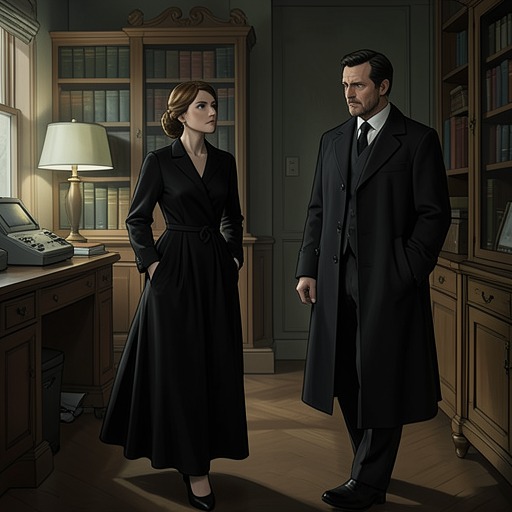
Mary Montrose
The Girl he Never NoticedMary Montrose is the sustaining center of Liz Montrose’s three-generation household: she cares for Scout while Liz works, provides the family’s domestic stability, and uses her gift for costume design to keep both herself and her daughter outwardly stylish despite limited finances. Her importance is practical rather than ornamental. The family’s later movement toward Yewarra depends partly on Mary’s willingness to reconsider the role she has built around Liz and Scout, and the story’s final marriage on Whitehaven Beach confirms her inclusion in the new family circle rather than her disappearance from it.
Identity and Background
Mary Montrose lives with Liz Montrose and Scout in an inner Sydney flat. The accommodation has three bedrooms and a small study, but the study has been converted into Scout’s bedroom and another room serves as Mary’s workroom. That room resembles an Aladdin’s cave: racks hold clothes in many colors and fabrics, while buttons, beads, sequins, feathers, ribbons, and motifs fill the space. The description establishes Mary as a maker whose creativity has been given a concrete domestic setting rather than remaining an abstract talent.
Her professional history is marked by both ambition and failure. After Liz’s father died, Mary pursued a lifelong dream by investing in her own boutique. The clothes were exquisite, but the business did not prosper because Mary had no business sense, and the venture nearly destroyed her resources. By the time of the story, she has a small group of customers for whom she creates garments, preferring that word to the more commercial language of ordinary dressmaking. Her work has therefore contracted in scale without losing its artistic identity.
Mary’s social knowledge also exceeds the modest circumstances of the flat. She follows Sydney’s social scene closely and immediately recognizes the importance of Narelle Hastings when Liz recounts her evening. Mary reveals that she once designed an outfit for Narelle, then works out that Narelle is Cameron Hillier’s great-aunt. Her interest in the social world is not merely gossip: it connects Liz’s precarious professional position to the wealthy network represented by Cameron Hillier and Narelle Hastings.
Family and Caregiving
Mary is the person who looks after Scout when Liz is working. Liz describes the arrangement as functional but demanding: Scout loves her grandmother, while Mary can be eccentric and sometimes needs care herself. Liz characterizes their shared life as a battle at times, but one they manage. The household therefore rests on reciprocal dependence. Mary is not presented simply as an endlessly capable grandmother; she is a woman with her own needs and limitations whose labor nevertheless makes Liz’s single motherhood possible.
Her love is expressed through creation as well as supervision. Mary’s two favorite people to design for are her daughter and granddaughter. As a result, Liz can operate on a fairly tight budget while still appearing exceptionally chic. Mary’s clothes become an indirect form of protection: they preserve Liz’s confidence and public presence without pretending that the family is financially secure. The contrast between the failed boutique and the elegance of Liz’s clothing makes Mary’s work both an economic necessity and an emotional gift.
Mary’s role also gives Liz the freedom to imagine change. When Cameron offers Liz a position at Yewarra, he identifies a staff cottage large enough for Liz, Scout, and Mary, and presents the arrangement as compatible with the household already in existence. Yet Liz eventually understands that accepting the post should not mean keeping Mary permanently confined to a caregiving role. She tells Cameron that one reason for taking the job is to give her mother the chance to have more of a life of her own and to do the work at which she is so good.
Response to Yewarra
Mary initially resists the prospect of remaining in Sydney while Liz and Scout move to Yewarra. When Liz reports Cameron’s proposal and the admiration he commands among his staff and nephew, Mary impulsively urges her to accept it. She sees the position as a career move that could open opportunities, relieve the family’s financial stress, and give Liz greater stature. Mary even offers to go with them, placing her own presence once again at the disposal of the younger household.
Liz refuses that immediate solution and explains that Mary is only fifty and needs a life of her own. The decision reframes the move. Yewarra is not simply a wealthy employer’s estate absorbing a single mother and her dependants; it becomes a test of whether care can be redistributed without erasing Mary’s identity. Mary is eventually persuaded to stay in Sydney and take up a costume-design job. She will still visit Liz and Scout at Yewarra, but she is no longer required to make all of her time and energy available as unpaid family support.
That choice carries an ambivalent emotional charge. Mary has sacrificed resources and years of independence for the family, so separation from Liz and Scout is not a clean emancipation. Nevertheless, the arrangement gives her a distinct professional future while preserving her connection with them. Her decision shows that devotion need not require permanent self-abandonment.
Place in the Wider Family Circle
Mary’s importance expands when Liz enters Cameron Hillier’s household. Cameron has adopted Archie, his sister’s orphaned son, and wants Liz to provide the child with a safe and happy final year before school. The proposed staff cottage is large enough for Mary as well as Liz and Scout, while Archie is offered as a ready-made friend for Scout. Mary’s position is thus connected to a broader structure of adoption, caregiving, employment, and chosen family.
The household at Yewarra is also sustained by women whose work is often treated as background: Mrs Preston coordinates domestic management and cooking, Daisy helps with childcare, and Mary’s own design and caregiving have supported Liz’s life in Sydney. Mary’s later arrival at Yewarra makes visible the continuity between these forms of labor. Wealth does not abolish care; it organizes care through cottages, staff, kitchens, nurseries, and paid or semi-paid responsibilities. Mary’s position remains emotionally familial even as the estate’s resources make the family arrangement possible.
When Liz and Cameron return from their travels, Scout and Archie are asleep, while Mary is there to greet them. She has also received assurances that Daisy is resting comfortably and that Mrs Preston, still in hospital, is being cared for. Her presence at this moment places her among the people responsible for holding Yewarra together during crisis. Cameron thanks her for stepping into the breach and asks whether she has moved into the house, greeting her with enough charm to make Liz see Mary blossom beneath it. The scene shows Mary being acknowledged not merely as Liz’s mother but as a valued participant in the household.
Ending and Significance
Mary is present at the marriage of Liz Montrose and Cameron Hillier on Whitehaven Beach several weeks later. The ceremony brings together Cameron, Liz, Archie, Scout, and the celebrant, with guests traveling from Hamilton Island on Leilani and another boat. Liz wears a dress Mary made: a strapless gown of ivory lace and tulle, with flowers woven into her hair. Mary’s artistry therefore becomes part of the public form of the marriage, turning the family’s private history of handmade clothing into a visible contribution to its new beginning.
At the wedding, Mary could not look happier. Her response is more than a mother’s pleasure at seeing her daughter marry. It completes the movement from the cramped Sydney flat, the failed boutique, and the exhausting arrangement of shared care toward a family structure in which her work, affection, and independence can all remain present. Her happiness also contrasts with the earlier uncertainty surrounding Liz’s escape from Narelle Hastings’s party and her first fearful arrival at Yewarra. By the end, the estate and its social world no longer signify only wealth and loss of control; they have become the setting for belonging.
Mary’s narrative function is consequently grounded in social reproduction as much as sentiment. She feeds and clothes the family, supervises Scout, absorbs financial consequences from her failed business, encourages Liz’s professional advancement, and then accepts a rebalanced life of her own. The final image of her joy at the beach confirms that the romantic resolution has not been purchased by sacrificing the older woman who made Liz’s independence possible. Mary helps transform marriage from a private union into the public recognition of an already functioning network of care.